
I was on a panel this evening about the future evolution of VR. At one point I made the argument that people who try to “make their film in VR” are getting it very wrong. In fact, I argued, VR is essentially the very opposite of cinema.
The most salient feature of a movie is that everybody in the audience sees exactly the same thing. The goal of a cinematographer, an editor, a lighting designer in movie making is, in fact, to optimize for a single viewpoint. The craft of filmmaking is built around this fundamental imperative.
In contrast, future content in VR will have far more in common with theater: Everybody will see events unfold from their own unique viewpoint. VR has even more in common with immersive theater, in which audience members are free to roam around on their own.
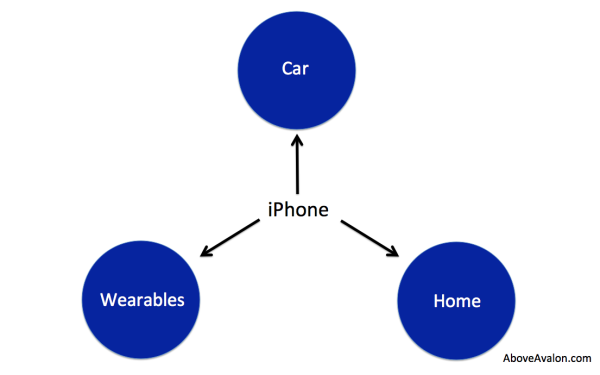
The New Apple Era →
The iPhone, iPad, and Mac are converging into one central "brain" while new platforms will be formed focused on key aspects of our lives including transportation, home, and body (wearables). In this new era, the iPhone is positioned as the center point of our digital lives with iCloud and Apple services representing the glue connecting everything together. […]
Neil believes, as do I, the iPhone will eventually fade away and the Apple Watch will become the real personal computer.
In the future, the iPhone may melt away, and a range of devices will be able to provide an unimaginable level of personal technology. Apple Watch will likely be able to stand on its own in due time. As the definition of work changes, more and more will be designated for the wrist, further strengthening the appeal of wearables. Transportation and the connected home will be looked at as providing the same kind of personal experience.
Smart Cars Will Change Cities →
Hence, if your car doesn't need to wait for you where you got out, then city-centre car parks disappear and retail gets remade (such of it as survives the shift to ecommerce, of course). No more worrying about parking. If you don't need to worry about parking yet can be driven there directly and affordably, how much travel shifts from public transport to cars? How many people visit a busy central area they might previously have avoided for that reason (the West End of London, for example)? But then, where does that car go afterwards - does it drop you off for dinner and drive off to a cheap carpark, or does it spend the next few hours driving other people around for a fee? The more autonomous cars there are, the more appealing on-demand becomes. Quite where the second-order effects end up is hard to predict - for example, where does it leave public transport if routes start emptying out, and what does that mean for people on very low incomes?
Like I said before: driverless, on-demand fleets of electric cars will transform humanity the same way the steam engine created cities and the automobile created suburbs.
Electric Smart Cars will Transform the World →
We stand on the threshold of what can realistically be described as the largest and most important shift in transportation in a century. The benefits will be enormous: An 80+ percent reduction in the cost of transportation. Reduced pollution. Reduced stress and road rage. A dramatic decrease in accidents and traffic deaths. Gaining back time lost to commuting — and the associated increase in productivity. Freeing up two lanes on many urban roads by eliminating parked cars. Even the reclaiming of the space allocated to home garages.
Driverless, Uber-style fleets of electric cars will change the way we live. The same way the steam engine created cities and the automobile created suburbs.
Suddenly, all these reports/rumors of Google and Apple researching and developing driverless cars seems much more than just a cool side project.
Scientists: Four-Hour Flight to Moon Possible with New Rocket Tech →
The drive is capable of producing thrust several thousand times greater than even a photon rocket and could get to Mars within 70 days or Pluto within 18 months. A trip to Alpha Centauri, which would take tens of thousands of years to reach right now, could be reached in just 100 years.
Mars in just 70 days?!
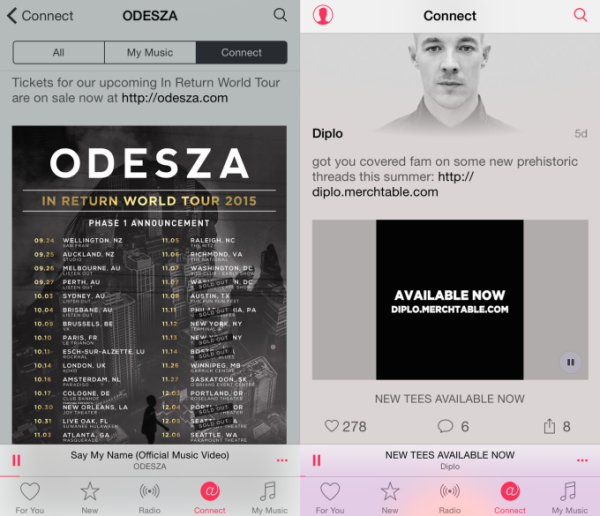
Apple Music's Grand Master Plan →
First, the songs get played on Beats 1’s primetime morning slots from 9am to noon PST, and start to appear on Apple’s Pandora-style iTunes Radio stations. Then artists drop them on the Apple Music Connect feed, which lets full songs be reshared on social networks like Twitter and Facebook. All of these channels are open to anyone on web or mobile without a $10 a month Apple Music subscription.
Apple’s editors can then push them into Apple Music’s For You or New tabs to score them even more plays from subscribers. Eventually in many cases, the singles get pulled back behind the paywall so they’re only available to subscribers to earn artists royalties, while the videos stay available for free.
What’s in it for the artist? To start, massive exposure. This is the modern Ed Sullivan Show, the Rolling Stone cover, the MTV Total Request Live. Smart musicians know that fame equals concert ticket and merch sales, sponsorships and licensing deals.
But rather than leave that relationship vague, this strategy gets people from around the web to follow artists on Apple Music Connect.
1926: Nikola Tesla Predicts the Modern Smartphone
Nikola Tesla, 1926:
When wireless is perfectly applied the whole earth will be converted into a huge brain, which in fact it is, all things being particles of a real and rhythmic whole. We shall be able to communicate with one another instantly, irrespective of distance. Not only this, but through television and telephony we shall see and hear one another as perfectly as though we were face to face, despite intervening distances of thousands of miles; and the instruments through which we shall be able to do his will be amazingly simple compared with our present telephone. A man will be able to carry one in his vest pocket.
Tesla Energy: Elon Musk's Plan to Save the World →
This dude is my fucking hero. He is not about money. He genuinely wants to save the world and help mankind.
And the craziest part is he very well might do all this in our lifetime.
Smart Devices & Dumb Screens →
This is exactly what I envision Apple will do with the iPhone. The iPhone matures enough to replace your PC and then you just wirelessly sling the interface to a variety of "dumb screens," whether it be a tablet-sized screen, a laptop-sized screen with a keyboard, a desktop monitor with keyboard & mouse, a TV, or even a car center console.
Then years down the line, the Apple Watch — or another computing device that is always on you — replaces the iPhone as the centerpiece of your digital life.
As for this Neptune Duo? It demos really well but A) it's too masculine-geeky for mainstream, and B) it'll be severals years until the technology is good & cheap enough to make this idea into something more meaningful.
iBeacons: Beyond Indoor Mapping →
AppleInsider explains Apple's recent patent application:
For example, if a user needed to visit the Department of Motor Vehicles, Apple's technology could determine which office has the shortest lines at any given time, and advise the user to visit that location.
In the event that the location cannot be changed, such as when the user has a flight scheduled, Apple's system could alert the user with reminders and give them a suggested time to arrive at the airport. Doing so would allow users accommodate for heavy traffic and help ensure that they arrive at their gate on time.
Apple's system would measure traffic by tracking data from a user's iPhone, measuring their movement over time. Those movements would be used to determine how long it takes for people to move through a specific location, estimating how long the lines might be at that particular spot.
"The server can determine how long mobile devices (and their users) loiter around locations of interest or remain in a queue," the filing reads. "For example, the server can analyze the indoor traffic information to determine how long (e.g., on average) mobile devices have to wait near a cash register location."
There is much more that can be done with indoor mapping than just mapping out shopping malls and having nearby stores push promos to your phone.
Apple may never catch up with Google Maps for outdoor mapping, so now, as I've said before, Apple wants to be the Google Maps (and Waze) for indoor venues.