
Artificial intelligence is getting so smart, it's a little scary... →

New York Times:

She is known as Xiaoice, and millions of young Chinese pick up their smartphones every day to exchange messages with her, drawn to her knowing sense of humor and listening skills. People often turn to her when they have a broken heart, have lost a job or have been feeling down. They often tell her, “I love you.”

To test it out, NYT had a little chat with Xiaoice:

NYT: I am feeling down. I’ve been having a tough time at work lately.

Hannah: If work were going well and you had a great relationship, you wouldn’t get the chance to drink with people.

NYT: I don’t want to drink with others. I only want to talk to you.

Hannah: Who do you like to talk to? (emoji signals “none of my business”)

NYT: You. I feel that you are the only person that gets me.

Hannah: Ha-ha/So I’m getting you?

NYT: You are the only person who chats with me.

Hannah: It’s not what you talk about that’s important, but who you talk with.

NYT: Of course.

Hannah: As you please.

All of a sudden, people falling in love with virtual personalities seems less like science fiction…
Typical iPhone Haters Be Like… →

Typical iPhone Hater:

So, basically your question is "Should I buy a device that uses the same technology as every other smart phone but costs substantially more, has few useful software features, hundreds of apps that all do the same thing, and will be considered gauche in a year?"

Yes. Because:

  • Apple's ecosystem is more tightly integrated with its own devices/software/services as well as major partner companies. Look at how many credit card companies and banks support Apple Pay.
  • iOS is more secure and reliable than Android. (See "Stagefright" exploit and "Google won’t fix security bug in nearly a billion Android phones")
  • iOS developers are quicker to adopt the latest APIs/features because iOS users update their OS far faster than Android. (iOS 9 adoption is at 50% in less than a week. Android Lollipop took 5 months to reach 12%.)
  • when iOS devices break, there is free face-to-face customer support at Apple Stores. And often times, they'll replace broken devices with brand new ones, for no extra charge. (Where do Android users take their phones when they break?)

All of those points have value that some consumers find worthy of paying a premium for. None of these points are ever highlighted in spec sheets, but they are real things that convert first-time Apple customers into happy, loyal ones.

Everyone wants to maximize their bang for their buck. But there are two kinds of people:

  1. those who focus on minimizing the cost
  2. those who focus on maximizing the value

Loyal Apple customers are the latter.

iOS: The Enterprise OS of the Millennial Generation →

Tim Bajarin:

This younger generation does use PCs. However, they actually spend the most time on their iPhones and iPads and Macs are mostly relegated to serious productivity projects. More importantly, they know iOS inside and out as they spend much more of their day in this operating system then they do on any computer they have. I believe Apple understands this better than anyone and their most recent iPad Pro is a nod to this trend. More importantly, I see Apple using this to drive millennials towards making iOS their OS of choice as they move into their careers and new jobs. In fact, within 5-7 years, I suspect Windows will not even be of interest to this younger set, as iOS will be the device operating system that dominates their work and personal lifestyles.

Apple playing the long game.

The New Apple Era →

Neil Cybart:

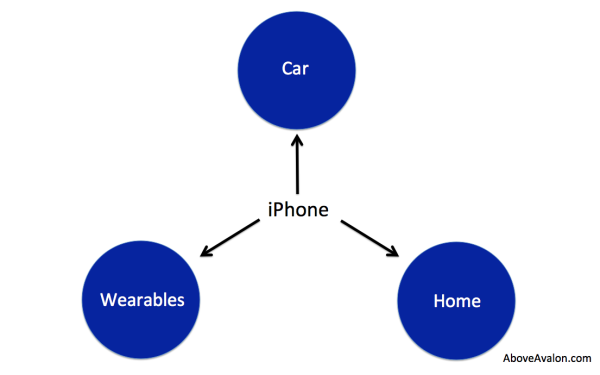
The iPhone, iPad, and Mac are converging into one central "brain" while new platforms will be formed focused on key aspects of our lives including transportation, home, and body (wearables). In this new era, the iPhone is positioned as the center point of our digital lives with iCloud and Apple services representing the glue connecting everything together. […]

Neil believes, as do I, the iPhone will eventually fade away and the Apple Watch will become the real personal computer.

In the future, the iPhone may melt away, and a range of devices will be able to provide an unimaginable level of personal technology. Apple Watch will likely be able to stand on its own in due time. As the definition of work changes, more and more will be designated for the wrist, further strengthening the appeal of wearables. Transportation and the connected home will be looked at as providing the same kind of personal experience.

Apple Watch is the new white earphones →

Jay Torres:

Now that I've had my watch for a few weeks, I definitely notice what people are wearing on their wrists. Maybe because I live in the Bay Area, with a lot of tech savvy people, I'm starting to see more people with Apple Watches on their wrists. [...]

The Apple Watch seems to be the iPod of this generation. When the iPod first came out in 2001, people were quick to criticize it. [...]

Soon enough, iPods were the gadget to have. People were sporting the iconic white headphones. An entire ad campaign centered around those ear buds. But in the early days, it was common to give a nod to others with the white ear buds since you knew they had an iPod as well. It's pretty crazy to think that before the iPod, no one else made white ear buds; all you had was standard black.

This reminds of the months leading up to my first iPod, my first Apple product ever. I remember walking around my college campus and just noticing everywhere, people wearing white earphones.

I started out noticing just 4-5 per day. And slowly, over time, I'd notice 4-5 an hour. On students leaving the dorms. On guys waiting for the campus shuttle. On people working out at the gym or eating alone. I distinctly remember those iconic white earphones appearing in the Winter Olympics, on NBA players warming up before marquee games, and the cult classic teen drama, The OC.

Nowadays, it's the Apple Watch that I'm noticing everywhere. On people at fast food restaurants. On shoppers at the mall. On tourists walking the Vegas strip.

And with social media, it's even easier to notice the Apple Watch on celebrities and politicians. Off the top of my head, there's been: Jay Leno, J.J Abrams, Kevin Durant, Santana, Bloomberg anchors, Larry King, Jeb Bush, and the Russian Prime Minister.

Sure, we're still early in the adoption cycle and more and more competing watches are coming onto the scene. But only one comes in that iconic rounded rectangle that is just so easy to spot from a distance.

This is how brand awareness begins.

Apple's Ace of Spades →

Charlie Warzel:

Most importantly, Apple has the massive user base to push its vision of the future into reality. The App Stores and Apple Pay sit on top of more than 800 million iTunes accounts with credit information. Put simply: Apple is adding features — its vision of the future — to devices you already use. That’s a great way to ensure that the future you are building works, instead of promising something world-changing you can’t deliver on.

While the tech media and everyone else argues over which company copied which, this is the one thing that no other company in the world can duplicate.

So every time Apple decides to launch a new paradigm — whether Apple does it first or not doesn't matter — the sheer number of Apple customers instantly makes it the gold standard for the rest of the industry to beat.

The iPhone Upgrade Plan is a Game-Changer →

Jan Dawson:

So why is this a big deal? Well, the reasons are fairly simple: it allows Apple to take over the primary relationship with the customer, relegating the carrier to a secondary role in relation to their device purchase. Yes, you’ll absolutely still have a direct relationship with the carrier, but it will now be exclusively around the service plan and you’ll no longer be dependent on the carrier for upgrading your device. You’ll now be able to put your carrier on autopilot while you have a much more active relationship with Apple, upgrading annually on a set schedule.

My favorite part about this is how it forces the carriers to compete. Looking forward to better reliability, customer service, and more competitively-priced service plans as the carriers bend over backwards to retain customers.

How the iPhone Can Grow in Emerging Markets →

Viranch Damani:

One possible solution is for Apple to sell refurbished devices in countries like India. In the US, the shift to leasing plans such as T-Mobile’s Jump on Demand and iPhone Forever program will make people return their iPhones every time they upgrade.

If these returned iPhones are refurbished, packed and sold again by Apple in emerging countries such as India at reduced rates they would sell very well. This will have two possible solutions:

  1. Apple would not have to develop a low-cost iPhone for emerging markets and risk possible cannibalization of the high-end.

  2. These refurbished iPhones, sold at reduced rates, will not only help Apple boost sales significantly but will help them maintain a good experience for the end users which is very important for Apple’s business model.

While all of the carriers are moving away from subsidizing to on-demand upgrading, all of these returned iPhones at the end of each lease will have to end up somewhere.

This is something that Android or Windows will never be able to do, simply because they don't have Apple's brand strength or smartphones that maintain a high enough resale value.

For Apple, U.S. carriers, iPhone users in the U.S, and potential iPhone customers in emerging markets, this is simply a win-win-win-win.

There is No More 'Mobile Internet' →

Benedict Evans:

For as long as the idea of the 'mobile internet' has been around, we've thought of it a cut-down subset of the 'real' Internet. I'd suggest it's time to invert that - to think about mobile as the real internet and the desktop as the limited, cut-down version. […]

Mobile is not a subset of the internet anymore, that you use only if you're waiting for a coffee or don't have a PC in front of you - it's becoming the main way that people use the internet. It's not mobile that's limited to a certain set of locations and use cases - it's the PC, that can only do the web (and yes, legacy desktop apps, if you care, and consumers don't) and only be used sitting down. It's time to invert that mental model - there is not the 'mobile internet' and the internet. Rather, if anything, it's the internet and the 'desktop internet'

Another great argument by Benedict, with several solid charts to boot.

Speed Test: iPhone 6 vs. Samsung Note 5 →

Buster Hein:

The Samsung Galaxy Note 5 is one of the most beefed up and powerful smartphones the world has ever seen. In terms of raw specs, the Note 5 blows the 2014 iPhone 6 out of the water with 4GB of RAM and a zippier processor, but as Apple has taught us for so many years, specs don’t always translate into better performance.

To see how fast the Galaxy Note 5 is compared to last year’s iPhone hardware, DroidModderX pitted the two devices against each other in a speed test designed to mimic everyday use, and the results were quite surprising. The iPhone is running on weaker hardware, but thanks to Apple’s software it managed to blow the Note 5 out of the water, thanks to Samsung’s horrible TouchWiz UI that bogs down all the memory.

Better specs does not equal better experience.

Smarter software > beefier hardware.