Re: Why CurrentC will beat out Apple Pay in the end →

Matthew Mombrea, IT World:

Apple Pay has the better technology but they lack the retail support to dominate. If you can't use Apple Pay almost everywhere, it's doomed. Some say that consumers will look to change where they shop based on their support of mobile payments but I have a hard time believing that. If anyone can pull this upset off it's Apple, but it will need the surrender of the largest retailers in the world who are fighting tooth and nail against credit card fees.

Good luck gaining consumer awareness of CurrentC in the first place.

Good luck getting consumers to download the CurrentC app vs. Apple Pay which will be built into every new iPhone model from this point on.

Good luck convincing consumers that holding up their iPhone with their thumb on TouchID is less convenient than:

  • Pulling out your smartphone from your pocket
  • Unlocking your smartphone
  • Opening your CurrentC application
  • Entering your 4-digit passcode
  • Pressing the Pay button
  • Either scannig the Secure Paycode that the cashier presents (default) or pressing the Show button at the bottom of your screen to allow the cashier to scan your Secure Paycode
  • Selecting the payment account that you would like to use
  • Pressing the Pay Now button

That's great that CurrentC is backed by a lot of big name retailers. But for mobile payments to catch on in the U.S., you need to satisfy multiple groups of players: consumers, merchants, credit card companies, and banks. Apple has solid backing by all four at launch time. CurrentC doesn't even have two.

Good luck with that.

UPDATE: CurrentC has already been hacked. LOL.
The End of Apps as We Know Them →

Intercom:

The idea of having a screen full of icons, representing independent apps, that need to be opened to experience them, is making less and less sense. The idea that these apps sit in the background, pushing content into a central experience, is making more and more sense. That central experience may be something that looks like a notification centre today, or something similar to Google Now, or something entirely new.

The primary design pattern here is cards. Critically it’s not cards as a simple interaction design pattern for an apps content, but as containers for content that can come from any app. This distinction may appear subtle at first glance, but it’s far from it.

I really love this cards metaphor that has been catching on lately; specifically, Google Now. And with the Smartwatch 2.0 era just coming around the corner, I think we'll be seeing this new design paradigm really start to blossom.

Remember, back in 2008 when the iTunes App Store was first introduced, nobody had any idea that we'd eventually have apps like Instagram, Snapchat, and Uber. I'm really stoked to think how wearable device user interfaces will evolve.

Dear Apple: Please Stop Selling the F'ing 16GB →

John Gruber:

I also understand the product marketing angle. That there are a lot of people who will look at the 16 GB models, see that they can get four times the storage for just $100 more, and buy the 64 GB model instead — when they would’ve bought the base model if it were 32 GB. I get it. There’s no doubt in my mind it’s good short-term business sense to go with a 16/64/128 lineup instead of 32/64/128. But Apple is not a short-term business. They’re a long-term business, built on a relationship of trust with repeat customers. 16 GB iPads work against the foundation of Apple’s brand, which is that they only make good products.

Apple has long used three-tier pricing structures within individual product categories. They often used to label them “Good”, “Better”, and “Best”. Now, with these 16 GB entry-level devices, it’s more like “Are you sure?”, “Better”, and “Best”.

Using the 16GB as a decoy price to make the 64GB more attractive is a great business strategy, but this only hurts customers and Apple in the longrun.

The biggest reason why people don't upgrade their iOS is because they don't have enough space on their devices and they have no idea how to manage it. Telling them, "just install via iTunes" is not enough. I know a lot of people that have never synced their devices with a PC. In fact, in many cases, they don't even have a PC to sync with in the first place. So what do they do? They don't upgrade. Ever.

The negative effects only grow from there. This Apple ecosystem becomes fragmented for developers because customers are spread out across different versions. This gives customers a fragmented experience because they have multiple Apple devices running different versions and can't take advantage of the killer integrations.

This is the exact opposite of Apple's "it just works" mantra.

Seriously, Apple. Don't turn into the greedy consumer electronics company that Apple-haters say you are. Don't sacrifice the ecosystem and user experience just to make more money in the short-term.

Customers like me are loyal to you for a reason. Please don't fuck it up.

The Second Wave of the Smartphone Era? →

Fred Wilson:

If the first wave of the mobile phone’s impact on the tech sector was driven by applications running on the phone, the second wave will be driven by the phone connecting to other devices, including other phones.

I am particularly fascinated about what happens when our phones connect to other phones in dense environments and form meshes that don’t need the traditional Internet connectivity to power them. Mesh networks don’t just solve the problem of lack of traditional connectivity (Hong Kong), they also produce a solution to the last mile connectivity duopoly in wireline and oligopoly in wireless. In the future we may just opt out of those non-competitive markets and opt into a local mesh to get us to the Internet backbone, both in our homes and when we are out and about.

Mesh networking will revolutionalize the way people connect in developing countries, the way we circumvent government censorship, and communicate in a post-apocalyptic zombie world. The future is bright.

What if Apple had an "iPhone For Life" program? →

Jan Dawson:

Apple is entirely capable of pursuing this kind of model itself. This could be either the carrier financing model, with the cost of a phone spread over a 12-24 month period, or an “iPhone for life” program under which a customer pays a fee each month to always have the latest iPhone model. Under the latter model, the older device would be handed back to be refurbed and resold when the customer gets a new phone. Apple has the deep pockets to fund such a model, and it would help to smooth out its revenues across the year too even as most of the upgrades continue to happen in the third and fourth quarters.

In short, the Apple SIM is a step in the direction of a new relationship between Apple customers, Apple and the carriers. But in order to reach its full potential in the iPhone context, Apple needs to make another significant change: allowing customers to spread the cost of owning an iPhone over a longer period. Only if it does that will the Apple SIM be truly disruptive.

Fascinating idea that I think would be a tremendous success. Imagine the possibilities for developers knowing that most iPhone users out there were using the latest and greatest hardware.

Why Apple took so long to make a large iPhone →

Jony Ive:

Many years ago, we made prototypes of phones with bigger screens. We made notebooks with bigger screens; it was a concept that we were familiar with. There were interesting features having a bigger screen, but the end result was a really lousy product because they were big and clunky like lots of the competitive phones are still…And we thought there is a danger you are seduced by a feature at the expense of making a great product. And so years ago we realized well this is going to be important that we have larger screens, but we needed to do a lot of things to make that larger screen yield a really competitive product.

It was very important to making [a phone with bigger screen] comfortable and actually feeling less wide than in reality it was.

You Actually Can't Use Apple Pay To Buy A Latte At Starbucks →

ReadWrite:

You can't buy a latte with your iPhone 6. Starbucks is only supporting the in-app version of Apple Pay. It will be "primarily for loading and reloading" your Starbucks Card, says Maggie Jantzen, a Starbucks spokesperson. Starbucks stores don't currently have the NFC technology needed to make use of Apple's tap-to-pay feature. [...]

Apple Pay will save you from having to enter in your credit- or debit-card number if you need to reload your Starbucks Card. But you're far better off just using the Starbucks app and keeping your card on file for automatic reloads. And it changes nothing about how you actually pay for your latte.

This is rather disappointing. Apple Pay needs to become a habit before it can really catch on with consumers. I like how McDonald's, Subway, Petco, Whole Foods, and Chevron are on the list of launch partners, but how many people go to these places on the daily basis? Starbucks customers get coffee EVERY DAY.

I'm still bullish on Apple Pay and (US) mobile payments in general, but early adoption would be much stronger if Starbucks were on board completely.

Will the Apple Watch be upgradeable? →

Business Insider:

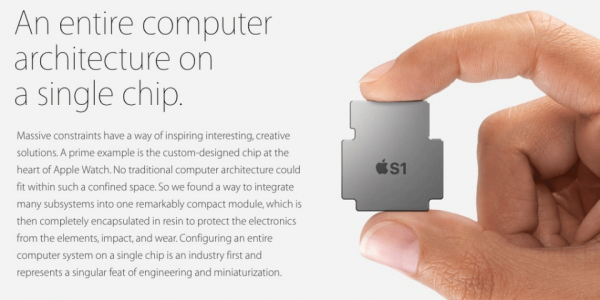
The wording here makes it sound as if there's a chance that Apple would be able to remove the S1 and replace it with, say, the S2 or S3 in the future. After all, Apple has the entire computer on one chip. It just has to rip out that little computer and replace it with a new one.

As Apple upgrades the computing power, it could replace the chip for, say, $500, Gruber suggests. This sounds high, but this is what it costs to service a high-end luxury watch every few years. If this were to happen, it would solve the problem of turning the watch into an obsolete brick after a few years.

This is only speculation but the potential for this is truly fascinating and it's the kind of innovative thinking I expect from Apple.

Every year, Apple proudly boasts how its latest iPhone is the thinnest, most powerful, and most power efficient iPhone ever. And every year, most of us yawn at it.

But what we're seeing now is the very best of Apple, using everything they've learned from compacting the iPhone to miniaturize an entire computer into a single chip. That alone is a huge innovative achievement. If the S1 chip ends up being swappable? Man, that would be a game changer for smartwatches.

Whatever Apple ends up doing, it's already pretty clear that Apple is approaching this as a modern, fashionable timepiece for the future, not a disposable $300 wannabe mini-smartphone for the wrist.

Windows 10 - Continuum Concept →

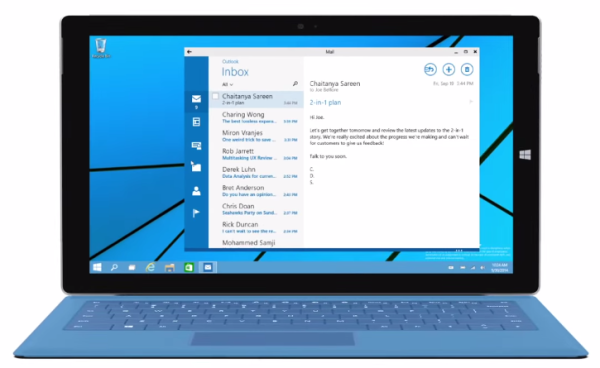
Now this is interesting. While I do believe there is a future for hybrid tablet-PCs, I do not believe the hardware technology is quite there yet. I'd love to one day be able to do full-time web development on a hybrid, while being able to hold my 500 GB of personal photos/video, and not having to pay over $999. That day will come eventually.

As for the software side, this "Continuum" concept seems like a great step in the right direction.

Why The Apple Watch Will Need The iPhone...For Now →

A Blog To Watch:

Apple actually made clever use of the Apple Watch's relationship with the iPhone. Apple Watch users will install an Apple Watch app on their iPhone, which will be used to download apps onto the watch as well as likely manage Apple Watch settings. A user's iPhone is also used to help with computational demands. Apple cleverly pushes a lot of processor needs to the phone in order to preserve Apple Watch battery life. Thus, the Apple Watch is snappier, with longer battery life because a lot of tasks can be off-loaded to the host phone.

Smart way to handle Apple Watch apps for the first few generations until the Apple Watch can stand on its own. Reminiscent of how the iPod first required iTunes and a computer until it evolved into the iPhone and iTouch.